
By CEDIA - Tue, Feb 17, 2026 - News, Installation Guides and FAQ's
As capacity demands for Internet of Things (IoT) devices increase, so too must Wi-Fi standards. Enter Wi-Fi HaLow: the long-range, next-gen Wi-Fi that’s been designed specifically for smart homes.
Working with IoT devices and smart home endpoints, Wi-Fi HaLow operates in the sub-1 GHz band. This makes it a low-power Wi-Fi, capable of penetrating dense walls in large properties.
With today’s breadth of devices, including sensor-based environmental monitoring and cameras, this long range is essential. Better still, it offers higher bandwidth than alternatives such as Zigbee or proprietary RF links, perfect for using multiple data-intensive devices at once.
Find out more about why integrators are turning to this next-gen Wi-Fi for more connected, secure smart homes.

Wi-Fi HaLow is the latest Wi-Fi standard that’s been optimised for IoT devices in smart homes. It boasts a long range of up to 1km in open air that can handle thousands of nodes per AP for high device density.
In particular, it works well with battery-operated devices thanks to its low power consumption. By operating in the sub-1 GHz band, it can also work against obstacles such as dense walls, outbuildings and basements. This makes it ideal for large properties with multiple connected devices.
Where traditional Wi-Fi might struggle, Wi-Fi HaLow was built with smart devices in mind. This means it can handle the high connectivity demands of smart home applications, including:
Integrators benefit because they are no longer bound by the 2.4/5/6 GHz bands limitations of traditional Wi-Fi. Homeowners know they can operate many devices at once, securely, and across large properties with dense structures.
While the low-power Wi-Fi capabilities of HaLow are ideal for high-activity homes, it’s important to remember that this is still new technology. As such, there are pros and cons to working with newer versus older Wi-Fi solutions.
| Features | Wi-Fi HaLow | Zigbee | Z-Wave | |
|---|---|---|---|---|
| Low power consumption | Yes |
|
Yes | |
| Frequency Band | 900 MHz | 2.4 GHz, 868 MHz, and 915 MHz bands (depending on region) | 868 and 908 MHz bands (depending on region) | |
| Small scale environments | No | Yes | Yes | |
| Medium scale environments | No | Yes | No | |
| Large scale environments | Yes | No | No | |
| Range | Up to 1km | 10 to 100m | 15 to 100m |
When communicating the return on investment, integrators should focus on HaLow’s:
Integrators should also be mindful of the following limitations of HaLow:
Crucially, HaLow complements Wi-Fi, rather than replaces it.
Installers can extol the benefits of Wi-Fi HaLow and enjoy simpler installation, so long as they consider scenario-specific limitations.
The benefits of Wi-Fi HaLow start from the point of sale. Integrators should promote its high coverage, ideal for large estates, farms or commercial/residential hybrids.
Installation is also simpler thanks to one Wi-Fi-based ecosystem rather than multiple radio frequency standards. Post-installation, improved battery life means that door and window sensors or leak detectors can last for years.
Thinking about aftercare, reduced truck rolls from stronger penetration and interference resistance enhance performance. This leads to fewer call-outs, and satisfies security needs for critical devices like locks or perimeter alarms.
The ideal smart home client for this long-range Wi-Fi would require expansive coverage. They might have gates, outbuildings, workshops or pool houses that can hinder traditional Wi-Fi. The layout may also not be suitable for Zigbee or Z-Wave mesh systems.
If your client requires multiple endpoints, HaLow can support many devices at once without impacting performance.
Before and during the installation, integrators should be mindful of the following obstacles:
All Wi-Fi HaLow projects should start with a site survey to determine ‘dead zones’ where traditional networks might fail. While HaLow does not need as many access points, their placement should also be evaluated for maximum efficiency.
As HaLow is still in its infancy, integrators should check device compatibility. Planning for hybrid networks is a future-proof method, combining HaLow for sensors and traditional Wi-Fi for AV or streaming.
When installing, choose HaLow for low-bandwidth, mission-critical endpoints. For enhanced security, there should be separate VLANs for IoT.
Access points must have sufficient UPS protection, promoting stable power for long-range systems. Finally, integrators should stay up-to-date with maintenance by documenting device firmware and HaLow radio settings. Find out more about high-efficiency networking for smart homes here.
Vendor fragmentation is a critical risk for integrators, and reputable manufacturers should always be chosen.
Client expectations also need to be managed. Wi-Fi HaLow is not meant for high-speed coverage, so customers looking for this should think about alternatives.
In the long term, Wi-Fi HaLow presents numerous opportunities for new service packages and ongoing revenue, including:
There’s also the competitive advantage of product differentiation. This next-gen Wi-Fi paves the way for new technologies. When clients need whole-property connectivity, experienced integrators can position themselves as the experts.
Before and during the installation, integrators should be mindful of the following obstacles:
All Wi-Fi HaLow projects should start with a site survey to determine ‘dead zones’ where traditional networks might fail. While HaLow does not need as many access points, their placement should also be evaluated for maximum efficiency.
As HaLow is still in its infancy, integrators should check device compatibility. Planning for hybrid networks is a future-proof method, combining HaLow for sensors and traditional Wi-Fi for AV or streaming.
When installing, choose HaLow for low-bandwidth, mission-critical endpoints. For enhanced security, there should be separate VLANs for IoT.
Access points must have sufficient UPS protection, promoting stable power for long-range systems. Finally, integrators should stay up-to-date with maintenance by documenting device firmware and HaLow radio settings. Find out more about high-efficiency networking for smart homes here.
Vendor fragmentation is a critical risk for integrators, and reputable manufacturers should always be chosen.
Client expectations also need to be managed. Wi-Fi HaLow is not meant for high-speed coverage, so customers looking for this should think about alternatives.
In the long term, Wi-Fi HaLow presents numerous opportunities for new service packages and ongoing revenue, including:
There’s also the competitive advantage of product differentiation. This next-gen Wi-Fi paves the way for new technologies. When clients need whole-property connectivity, experienced integrators can position themselves as the experts.

Thu, Apr 2, 2026
CEDIA Announced as Official Technology Sponsor of WOW!house 2026
Mon, Mar 30, 2026
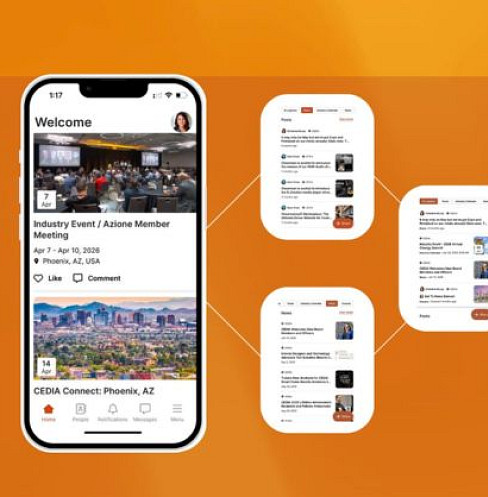
CEDIA Introduces First-Ever Integration Industry Calendar via CEDIA App
Thu, Mar 26, 2026
CEDIA Launches Integrator Advantage Program for Australian Members
Thu, Mar 26, 2026
CEDIA Smart Home Awards: The Business of Winning
Tue, Mar 17, 2026
CEDIA Named Knowledge Partner for Smart Home Expo India