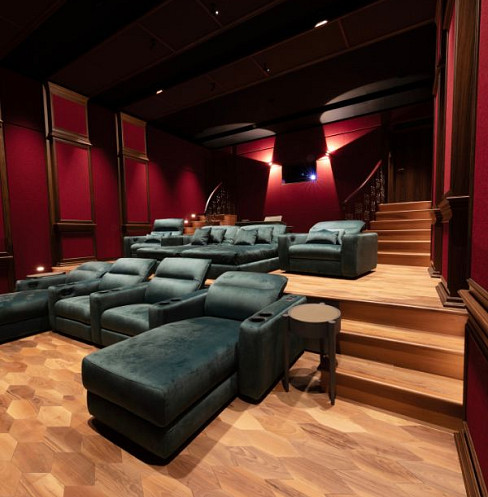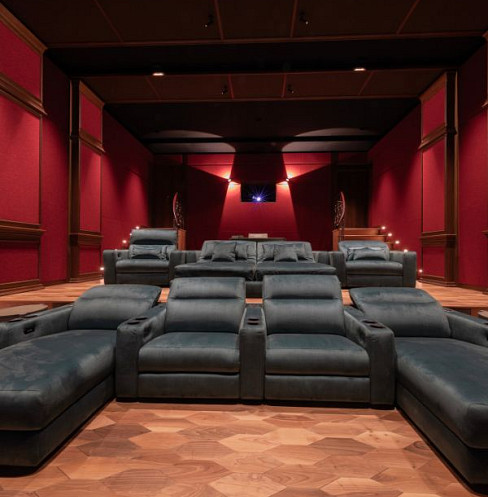
The room sits on a sprung concrete slab, inside its own structure, with a custom heavy door and a purpose-built window for the projector, so sound can’t travel in or out. The air conditioning had to work in a hot, humid climate while staying virtually silent, so Cinema Buro adapted it to use locally serviceable equipment, with silencers that need no maintenance.
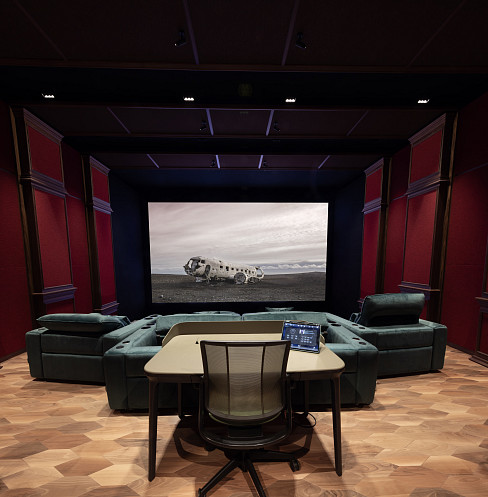
The sound and picture are built to the highest standard. The bass reaches down to 7 Hz, below human hearing, so the effects in a film soundtrack can be felt, and the system was designed so that every seat gets a consistent experience. The projector can play first-run commercial cinema releases, which is rare in a private home. The system was measured against the industry’s top performance level, RP-22 Level 4, and Trinnov’s modelling put it as the most even room they had simulated at the time.
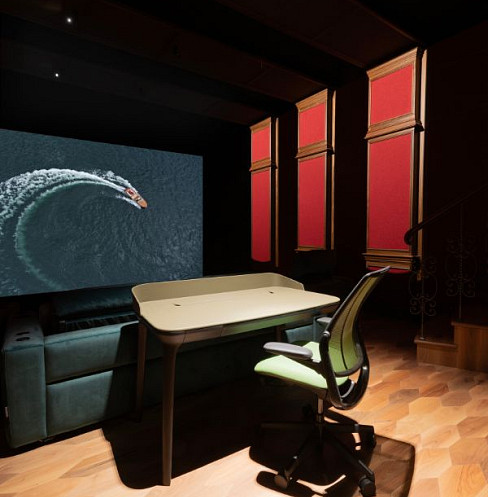
One result nobody planned: the isolation made the cinema the quietest room in the whole house. The client saw an opportunity, so the team redesigned the back of the room to include a writing desk and hidden storage, and it is now his preferred workspace, as well as a cinema, music room and place to unwind.



A bespoke power-up and power-down system was engineered using a Siemens programmable logic controller and high-quality long-life contactors, triggered by a single 12V signal from the Trinnov processor, so the entire sequence runs automatically from one user action.
A CO2 sensor was used to regulate fresh-air supply according to actual occupancy rather than running at full capacity continuously, with cooling and dehumidification engineered as two independent control loops so temperature and moisture could each be managed precisely without working against one another.
The rear seating riser geometry was reworked to introduce a bespoke writing desk and concealed storage without intruding into the projector's laser hazard zone, letting the room take on a second life as the client's preferred workspace without compromising any performance criterion.