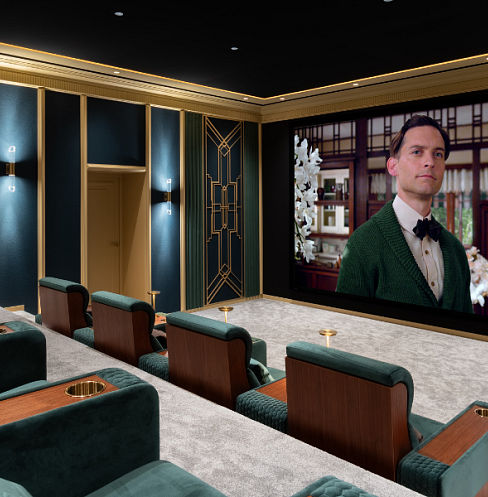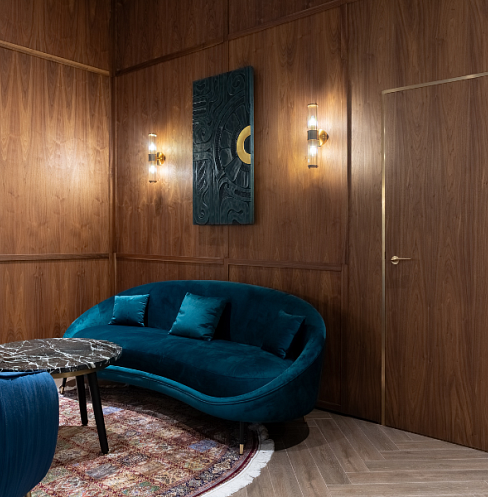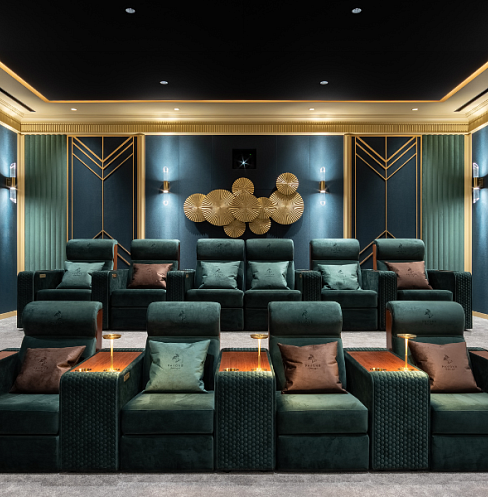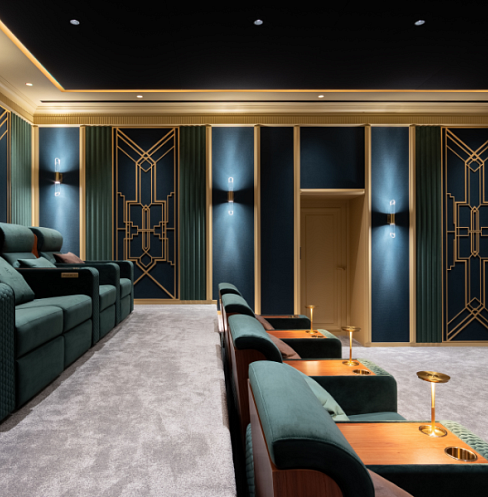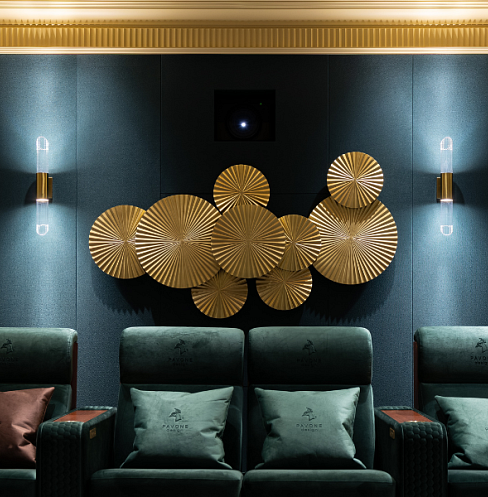
He wanted a near-complete turnkey solution delivered on budget, built around the estate's existing interior design language, simple enough to operate without thought, and impressive enough to leave his friends talking.
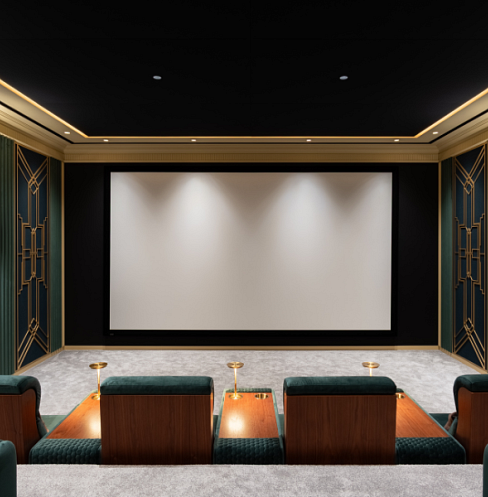
Blackroom built the cinema around a strong 55.2 sq. m room with over 4 metres of ceiling height, working from a technically pre-populated 3D model that let an Art Deco interior concept develop in parallel with precise loudspeaker, subwoofer, and projector placement rather than retrofitting technology after the fact.
The system targets CEDIA RP22 Level 3 performance, centering on a Dolby Atmos 9.1.6 configuration with eight 15-inch servo-controlled subwoofers, a 180-inch screen, and an iPad-based RTI control interface, all run from equipment isolated in a dedicated technical room behind the cinema.



Every loudspeaker and subwoofer was integrated in coordination with the designer's decorative scheme, with acoustic panels placed behind acoustically transparent fabric alternating with solid decorative elements.
A through-opening was created to recess the box while preserving most of the isolation shell. Originally planned open ceiling-suspended projector would have introduced heat and noise into the room, so the projector was moved into a custom ventilated hush box designed in-house, eliminating fan noise and thermal buildup from the listening environment.
The HDL smart touch panel was replaced with an analogue three-button Bticino switch wired to the HDL module's dry contacts, giving instant tactile feedback without sacrificing the underlying smart system.
Subwoofers were connected in pairs across four Trinnov processor channels, enabling separate, independently calibrated bass presets for the first and second rows.