Sep 30, 2026 • Last Updated: Oct 2, 2026 • Blog, Guides and FAQs


Many homeowners who want a smart home don’t know who to call to help them achieve their vision. Some struggle to understand the benefits of a professional installation in comparison to a DIY approach. Others are unsure what the differences are between CEDIA-certified smart home installers and general electricians.
In this guide, we’ll explain the specialized role of a CEDIA-certified Smart Home Professional, what they do, and the advantages of using an expert.
A CEDIA-certified Smart Home Professional doesn’t just ‘plug things in’. Although some off-the-shelf devices are plug and play, a qualified installer’s role involves creating a connected system, which is significantly more complex.
CEDIA professionals are technology integrators. They design, specify, configure, and support complete smart home systems. Their work spans having consultations with homeowners, designing suitable systems, and installing technology. As part of the installation process, they wire devices, set up components, and train homeowners on how to use them. Many will also offer long-term maintenance to complete updates, make adjustments, and keep everything working as intended.
Unlike a standard electrician, CEDIA-certified smart home installers specialize in smart home and audio visual (AV) technology. CEDIA certification holders use their extensive knowledge to recommend which devices work best in one connected system for a smart home. They recommend systems across many reliable manufacturers to ensure the best possible experiences, considering homeowners’ personal needs and cross-device compatibility.
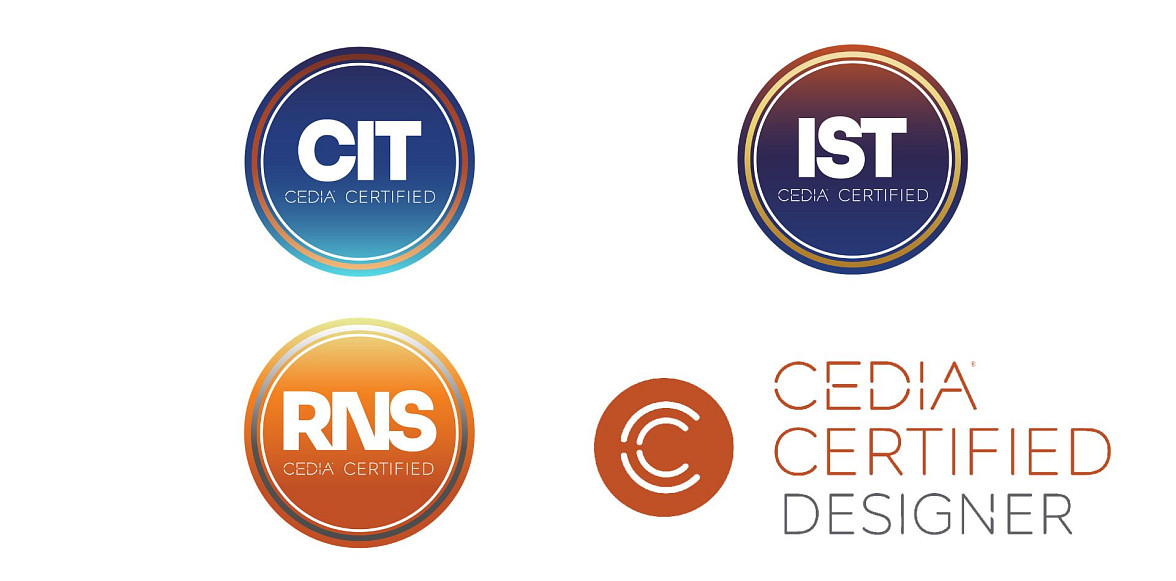
CEDIA offers four certifications that are specific to smart home technology and custom integration. The certifications recognize a Smart Home Professional’s knowledge and skills across design, installation, and system integration.
|
Certification |
What it covers |
Why it matters |
|---|---|---|
|
Cabling & Infrastructure Technician (CIT) Certification |
Basic infrastructure wiring for limited energy technology systems in a residential or commercial setting. |
Provides technicians with the foundational knowledge to use the right tools with proper techniques, follow instructions, and work safely and professionally. |
|
Integrated Systems Technician (IST) Certification |
The skills for experienced smart home technicians to perform all functions related to the construction of an installation project, including troubleshooting and ensuring system functionality. |
Gives installers a deeper understanding of how technology systems work and the ability to solve more problems. |
|
Residential Networking Specialist (RNS) Certification |
Advanced knowledge of networking and technical skills necessary to design, configure, troubleshoot, and maintain secure networks in residential settings. |
Gives integrators the expertise to manage high-performance systems and understand a wide range of network configuration techniques to ensure system reliability. |
|
Designer Specialist (ESC-D) Certification |
Overall smart home system design, including how to select appropriate products, create schematics and drawings, budget, and design programs. |
Proves the high level of technical competence necessary to lead on system designs and manage a smart home project through to completion. |
To become certified, integrators need to pass an exam, sign a code of ethics, and maintain proficiency through ongoing learning. Each certification reflects a different level of experience and skill set. While the CIT is available to technicians in the early stages of their careers, the ESC-D is a specialist certification that requires a minimum of five years of experience.
Unlike some industry accreditations, CEDIA certifications are held by individuals rather than companies. This means every CEDIA-certified tradesperson has been individually assessed, not simply employed by an accredited company.
To stay certified, CEDIA members must keep up to date with evolving technology through continued professional development.
Some CEDIA-certified professionals may take on slightly different roles depending on the level of their certification. For example, a smart home technician with a CIT certification will generally focus on fundamentals. However, working with a team of CEDIA-certified professionals or an experienced individual will usually follow four stages.
A CEDIA professional will listen to the homeowner to find out how they live and what they want to achieve from smart home installation.
They will also survey the property to identify any infrastructure requirements. Using the information they gather, they’ll design a system that integrates various smart home elements, including lighting, security, climate control, and AV, into one unified setup. CEDIA-certified smart home installers will recommend the system’s individual components based on performance and compatibility.
At the installation stage, a CEDIA smart home technician will manage wiring, network infrastructure, and device set-up. As part of the configuration, they will program automation sequences that align with the homeowner’s desires. For example, they can automate lights to turn on with motion.
Typically, a CEDIA-certified integrator will design a smart home that works through a single control interface. This means a homeowner can control all elements, including lighting and heating, through one central interface, such as a phone-based app, a mounted tablet, custom keypads with pre-programed scenes, or even a voice assistant.
CEDIA professionals will also coordinate with other tradespeople, including architects, builders, and general electricians, to ensure a seamless experience across the home and a smart home system that aligns with other planned renovations.
A CEDIA-certified Smart Home Professional will guide the homeowner through how everything works before they leave. They will also provide full system documentation so that the occupant will always know what is installed, how it is configured, and how it works. While written documentation is important, CEDIA professionals intentionally design systems that are intuitive and easy for everyone in the household to use without an instruction manual.
With an aftercare agreement in place, a CEDIA professional can offer additional smart home services, including ongoing troubleshooting and updating the system after installation. Integrators can also expand or adapt the system as needs change over time.
The option of ongoing maintenance offers long-term reliability that standalone DIY setups can’t match.
A CEDIA professional brings specialist expertise that neither a generalist electrician nor a DIYer will have.
While an electrician can wire a home and ensure device safety, they’re rarely trained in system integration, automation logic, or AV systems. As a result, it’s unlikely that they will be able to advise on creating a unified smart home system as competently as a dedicated Smart Home Professional.
As for DIY options, there are some standalone smart home products, such as video doorbells and smart speakers, that are accessible and available to buy off the shelf. However, these individual devices rarely produce a cohesive, whole-home solution. Without professional guidance, many DIYers will come across compatibility issues when they try to get their disparate devices to ‘talk’ to each other.
A CEDIA professional can use their specialist expertise and training to cover the full stack: design, installation, configuration, and aftercare. Although DIYers and electricians can install some smart home solutions, such as smart bulbs in a single space, Smart Home Professionals are usually necessary to create complex setups. In multi-room systems with automation routines, device interoperability and network reliability are critical. CEDIA professionals can ensure everything works together as desired.
|
DIY / Generalist Electrician |
CEDIA-certified Professional |
|
|---|---|---|
|
System design |
Reactive, device-by-device |
Whole-home planning from the start |
|
Product knowledge |
Limited to familiar brands |
Brand-agnostic, cross-ecosystem expertise |
|
Integration |
Single devices or apps |
Unified control across all systems |
|
Certification |
None (for smart home specifically) |
Industry-accredited, exam-tested |
|
Aftercare |
Often none |
Ongoing support and maintenance |
|
Future-proofing |
Limited scalability |
Designed to grow with your needs |
CEDIA professionals work with all technological elements within a smart home, including:
In addition to understanding each type of technology, CEDIA professionals understand full smart home integration and know how to unite all of the above with one control interface. Part of this is made possible by their knowledge of networking and infrastructure, which is core to ensuring everything reliably connects and works together.
If you’re ready to begin your smart home journey, use the CEDIA Find a Professional directory to locate certified members in your area. Look for individual certifications (not just company membership) when evaluating candidates.
While you can be assured that every CEDIA member will work at a professional standard, it’s worth asking to see examples of previous projects and requesting references from comparable installations. This can help you determine if the type of smart home technology they install matches what you’re looking for.
During your search, it’s also important to discuss how much you’re prepared to pay, your ideal timeline, and which elements matter most to you. Talking about these factors as early as possible helps ensure that the project will meet your needs while staying within your budget. However, avoid choosing based on price alone. Expertise and aftercare are often where the real value lies. Sometimes, it’s worth investing a little more to get the exact smart home system you want.
A CEDIA-certified professional is more than an installer. Instead, they are a long-term partner in making your smart home work the way you want it to.
While generalist electricians may be able to safely do more than a DIYer, specialized smart home certification provides a clear signal that the person creating your smart home has the knowledge and skills to carry out the work competently.
Tue, Oct 13, 2026
Renovations: Smart Home Decisions to Make Early
Sun, Oct 11, 2026
Smart home systems that actually add value when you sell your house

Mon, Oct 5, 2026
What to Ask a Smart Home Installer Before They Start
Wed, Sep 30, 2026
What does a CEDIA-certified Smart Home Professional actually do?